AI vs Traditional Software: What Kathmandu Enterprises Need to Know
A decision framework for Nepal's growing tech sector
2026-02-05 • 20 min read
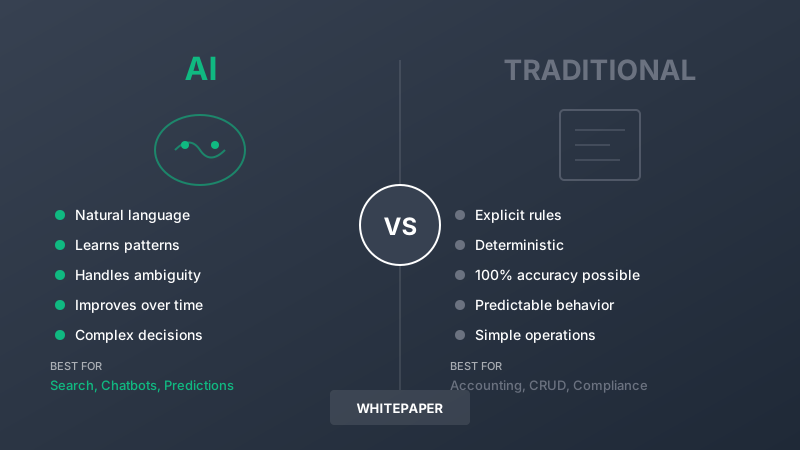
The AI hype vs reality
79% of Nepali industries are not yet ready for AI adoption. That's not necessarily a problem. Not every business process benefits from AI, and rushing into AI can waste resources on solutions that don't fit.
This whitepaper provides a practical decision framework for Kathmandu enterprises. When does AI deliver clear ROI? When is traditional software the better choice? And when should you consider hybrid approaches?
Decision matrix: AI vs Traditional
| Criteria | Choose AI | Choose Traditional |
|---|---|---|
| Data volume | Large, unstructured | Small, structured |
| Rules | Complex, hard to define | Clear, explicit |
| Accuracy need | "Good enough" acceptable | 100% required |
| Patterns | Hidden, evolving | Known, static |
| Input type | Natural language, images | Forms, structured data |
When AI delivers clear ROI
Customer service automation
Chatbots handling FAQs, ticket routing, and basic support. 60-80% of queries can be automated.
Document processing
Extracting data from invoices, contracts, and forms. Reduces manual entry by 80%+.
Search and discovery
Finding information in large content repositories. Users find answers 3x faster with AI search.
Predictive maintenance
Manufacturing and construction. Predict equipment failures before they happen.
When traditional software is better
Accounting and compliance
When 100% accuracy is required and rules are clearly defined. AI adds risk without benefit.
Simple CRUD applications
Basic data entry, inventory tracking, scheduling. Traditional software is simpler and cheaper.
Low data volume
When you have hundreds, not thousands, of records. AI needs data to learn patterns.
What you get:
- AI vs traditional software: Decision matrix
- Use cases where AI delivers clear ROI
- When traditional software is the better choice
- Hybrid approaches for gradual AI adoption
- Risk assessment framework
- Nepal-specific considerations and case examples
Frequently asked questions
Is AI always more expensive than traditional software?
Not necessarily. Cloud AI services (chatbots, document processing) can be cheaper than custom development. The cost depends on the use case, not the technology. This whitepaper includes cost comparison frameworks.
Can we start with traditional and add AI later?
Yes, and this is often the best approach. Start with traditional software to establish processes and collect data. Add AI once you have clear use cases and sufficient training data.
What about hybrid approaches?
Many successful implementations combine AI and traditional software. AI handles ambiguous inputs, traditional rules handle clear-cut cases. The whitepaper covers patterns for hybrid architectures.